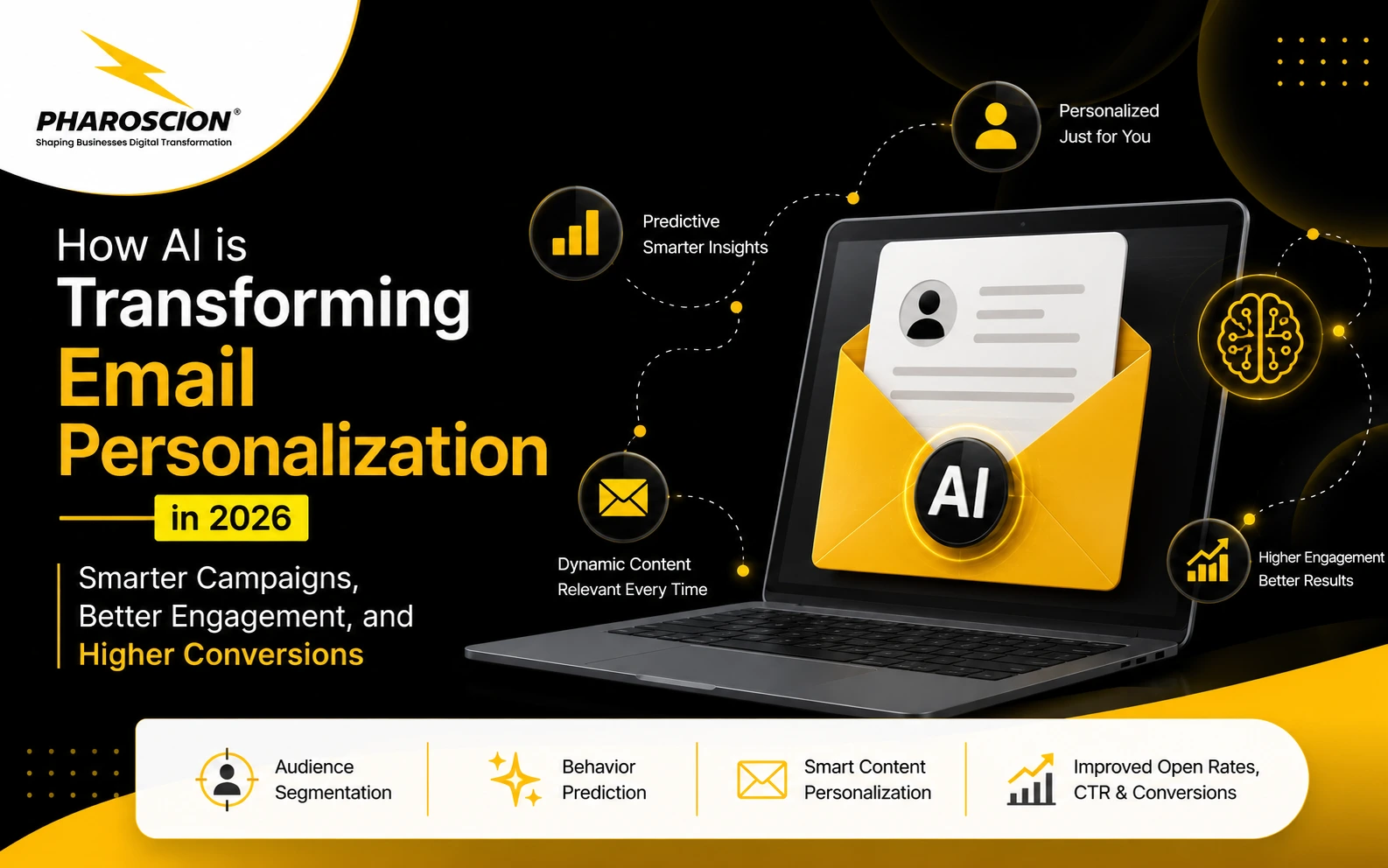
Email marketing continues to deliver one of
the highest returns on investment in digital marketing, but in 2026, success is
no longer about sending the same message to thousands of subscribers.
Artificial Intelligence (AI) is redefining how brands connect with their
audiences by enabling highly personalized, data-driven, and timely email
experiences.
Pharoscion
believes that AI-powered email personalization is not just a marketing trend - it
is becoming the foundation of effective customer communication. From
understanding user behavior to predicting purchase intent, AI is helping
businesses create emails that feel relevant, valuable, and personalized for
every recipient.
Why Email Personalization Has Changed
Traditional email personalization was
largely limited to adding a customers first name or segmenting subscribers
into broad audience groups. While these techniques were once effective, todays
customers expect brands to understand their preferences, interests, and buying
behavior.
AI enables marketers to move beyond basic
personalization by analyzing customer interactions across multiple touchpoints.
Instead of relying on assumptions, AI continuously learns from user behavior to
determine what content, offers, and messaging are most likely to resonate with
each individual.
For example, if an online shopper
frequently browses fitness products but has not completed a purchase, AI can
automatically send an email featuring similar products, customer reviews, or a
limited-time discount. This level of personalization creates a more relevant
experience and increases the likelihood of conversion.
Predictive Personalization is Driving Better Customer Experiences
One of the biggest advantages of AI is its
ability to predict future customer behavior rather than simply reacting to past
actions.
Machine learning algorithms can analyze
browsing history, purchase frequency, abandoned carts, product interests, and
engagement patterns to anticipate what a customer is likely to need next. This
allows businesses to send proactive recommendations before customers even begin
searching.
For example, a subscription-based software
company can automatically identify users who have not explored key features and
trigger personalized onboarding emails with tutorials and tips. Similarly, an
e-commerce brand can recommend complementary products based on previous
purchases, increasing average order value while enhancing the customer
experience.
Predictive personalization transforms email
marketing from reactive communication into intelligent customer engagement.
AI Creates Dynamic Content for Every Subscriber
Modern AI-powered email platforms can
generate dynamic email content that changes based on individual user profiles.
Instead of creating multiple campaigns for
different audience segments, marketers can build a single email template that
automatically adjusts product recommendations, promotional banners,
call-to-action buttons, images, and messaging according to each recipients
preferences.
For example, an international travel
company can send one promotional campaign where customers in Europe see summer
holiday packages, while customers in Asia receive recommendations for nearby
destinations during local festive seasons. The campaign remains the same, but
the content adapts to every subscriber automatically.
This level of automation saves time while
delivering a highly personalized experience.
Optimizing Send Times with AI
Timing has always played an important role
in email marketing. Sending the right email at the wrong time often leads to
lower open rates and missed opportunities.
AI solves this challenge by identifying
when each subscriber is most likely to engage with emails. Rather than sending
campaigns at a fixed time for everyone, AI platforms analyze historical
engagement patterns and deliver emails when individual recipients are most
active.
For example, one subscriber may
consistently open emails during their morning commute, while another interacts
with marketing emails late in the evening. AI ensures that each user receives
the campaign at the optimal time, improving visibility and engagement without
additional manual effort.
Smarter Customer Journeys Through Automation
Email automation has existed for years, but
AI is making customer journeys significantly more intelligent.
Instead of following fixed workflows,
AI-powered automation adapts based on customer behavior in real time. Every
interaction influences the next step in the journey.
Consider an online fashion retailer. If a
customer browses several products without making a purchase, AI may first send
a product reminder. If the customer clicks but does not buy, the system may
follow up with customer reviews or styling suggestions. If there is still no
purchase, AI might later send a personalized discount or notify the customer
when the item is back in stock.
This adaptive journey creates a natural
conversation rather than a sequence of repetitive promotional emails.
AI Improves Subject Lines and Email Copy
Creating compelling subject lines has
traditionally required extensive A/B testing and creative brainstorming. AI now
assists marketers by analyzing millions of data points to predict which subject
lines are likely to generate the highest open rates.
Beyond subject lines, generative AI can
help draft email content, personalize messaging, recommend calls-to-action, and
even adjust tone based on audience preferences. Human creativity remains
essential, but AI significantly accelerates content creation while improving
performance.
For example, an AI platform may recommend
using urgency for one audience segment while suggesting educational messaging
for another, depending on previous engagement behavior.
Better Analytics Lead to Better Decisions
AI is not only improving email delivery but
also transforming how marketers measure campaign success.
Instead of focusing solely on open rates
and click-through rates, AI platforms analyze deeper behavioral patterns, identify
customer intent, predict churn, and recommend optimization opportunities.
For example, AI may discover that users who
click on educational blog articles are twice as likely to become paying
customers than users who only click promotional offers. These insights help
marketers prioritize content that contributes to long-term business growth
rather than short-term engagement.
By turning raw data into actionable
recommendations, AI enables more informed marketing decisions.
Challenges Businesses Should Consider
Although AI offers remarkable
opportunities, successful implementation requires careful planning.
Businesses must prioritize customer
privacy, maintain compliance with regulations such as GDPR, and ensure
transparency in how customer data is collected and used. AI-generated content
should also be reviewed by marketing teams to ensure accuracy, consistency, and
alignment with brand voice.
Most importantly, personalization should
always enhance the customer experience rather than feel intrusive. Customers
appreciate relevant recommendations, but excessive tracking or overly
personalized messaging can reduce trust.
The most successful brands use AI
responsibly while maintaining authentic human communication.
The Future of Email Marketing is Intelligent
As AI technology continues to evolve, email
marketing will become increasingly predictive, conversational, and
customer-centric. Businesses that adopt AI-powered personalization today will
be better positioned to build stronger relationships, increase engagement, and
improve conversion rates.
Rather than replacing marketers, AI
empowers them to work more efficiently by automating repetitive tasks,
uncovering valuable insights, and delivering personalized experiences at scale.
Organizations that combine AI capabilities
with strategic creativity will set the benchmark for successful email marketing
in the years ahead.
Conclusion
Pharoscion
helps businesses embrace AI-driven marketing strategies that create meaningful
customer experiences across every stage of the buyer journey. From intelligent
email automation and personalized content to advanced analytics and performance
optimization, AI is transforming email marketing into one of the most powerful
channels for customer engagement.
As personalization becomes the expectation
rather than the exception, brands that invest in AI-powered email marketing
today will be better equipped to build stronger customer relationships, improve
campaign performance, and drive sustainable business growth.
Useful Resources & Links
Pharoscion Blogs
https://www.pharoscion.com/blogs
White Papers:
https://www.pharoscion.com/white-papers
Case Study:
https://www.pharoscion.com/case-studies